
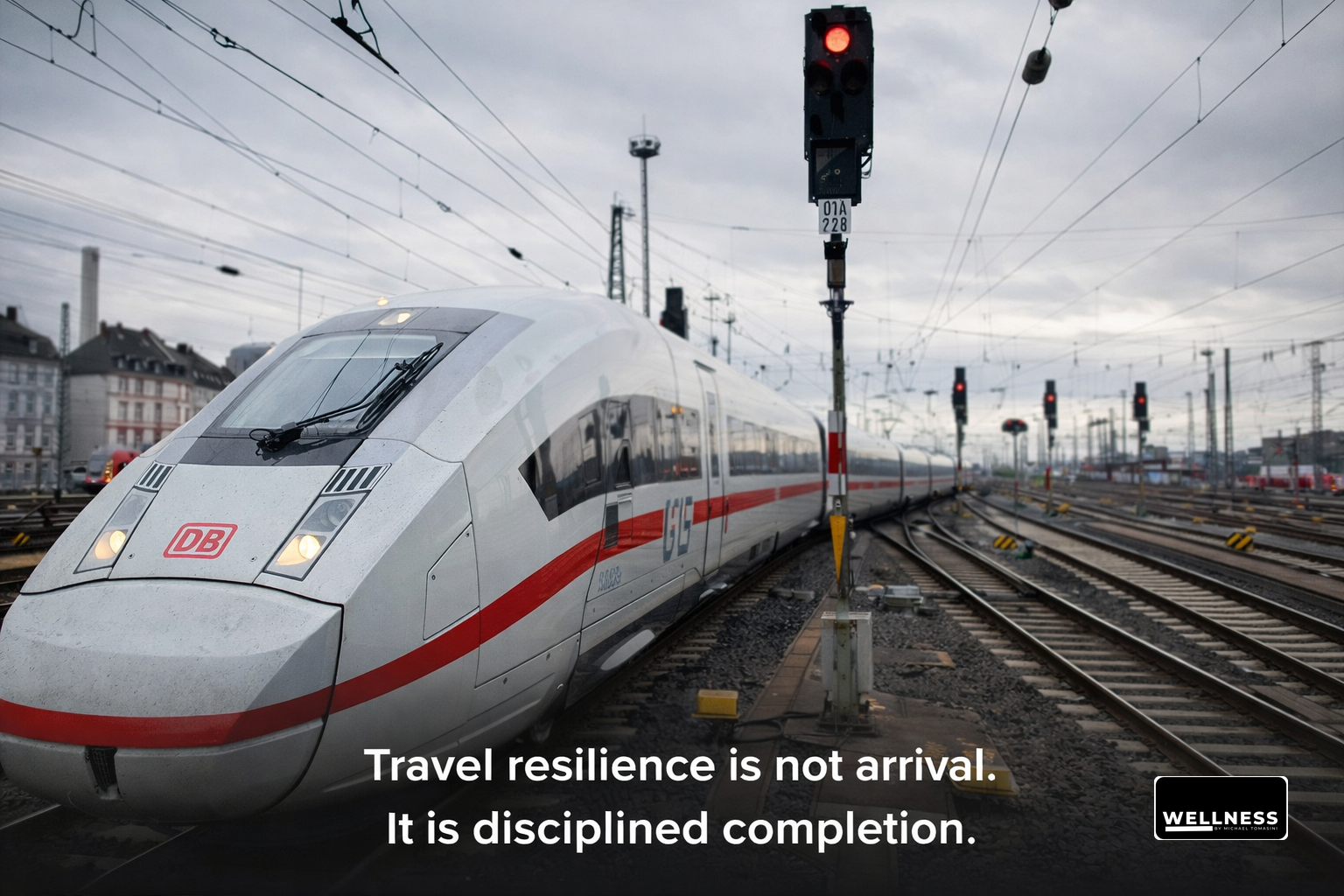
Travel Resilience: What India, a Lufthansa Cancellation, and a Train Party Taught Me
Business travel usually gets described in clean, efficient language.
Flights. Meetings. Hotels. Transfers. Deliverables.
But that is not how it actually feels when you are inside it.
Some trips remind you that travel is not a linear process. It is a test of how well you can stay functional when the plan starts to break apart. That was the real lesson from my recent trip to India.
The week gave me three very different experiences.
First, genuine hospitality in Mumbai.
Then, a Lufthansa cancellation that could have unraveled the return completely.
And finally, an unexpectedly human train ride in Germany that reminded me recovery does not always happen in silence.
Taken together, they taught me more about travel resilience than any perfect itinerary ever could.
I landed in Mumbai with about an hour of delay, but the arrival itself went smoothly. I was near the front of the aircraft, had my paperwork ready, carried only a small business carry-on, and moved through the airport without any real trouble. Outside, I met my chauffeur and headed into the city.
That first drive already set the tone. We passed high-rise towers and slums in the same journey. Mumbai did not present itself as one simple story. It arrived layered, intense, and real.
At the hotel, I checked in early, cleaned up, ironed my shirts, and reset properly after the flight. That sequence mattered more than it sounds. On a business trip, those small acts are not vanity. They are recovery. They help turn you from passenger back into operator.
Later in the trip came one of the highlights of the entire week: a hotel dinner in India that reminded me how much the quality of a travel experience depends on people.
I had intentionally kept the earlier meals light and came into dinner with a clear plan. I wanted to focus on protein where possible, but I also wanted to stay open to the local cuisine. Not rigid. Not reckless. Just aware.
That balance paid off.
The staff did much more than serve food. They guided the experience. They asked about allergies, spice tolerance, and preferences. They walked me through local dishes, explained regional differences, and helped me navigate the buffet in a way that felt personal rather than transactional. I tried a wide range of Indian food in small portions, including dishes I would never have chosen confidently on my own.
That meal stayed with me because it captured something important: openness is not the opposite of discipline. In travel, openness can be a form of discipline. It takes awareness to stay curious without losing your footing.
That spirit was still with me on Wednesday evening when the next phase of the trip started to go wrong.
At 18:26 on Wednesday, while meeting with a colleague and preparing for a 19:00 dinner with my Indian coworkers, I received the notification that my Lufthansa return flight had been cancelled due to the pilots’ strike. My original flights were supposed to begin on Thursday at 22:45.
That kind of message can hijack an entire evening.
This time, it did not.
I kept my cool, stayed present, and enjoyed the dinner with my colleagues. Only afterwards did I switch into damage-control mode. I contacted the travel agency and spent far too long on hold. They were not useful. I had to work through the problem myself.
That is where resilience becomes practical.
I started evaluating options. Some were out of budget. Some were out of compliance. Others would have delayed me by a week or more. In the end, I found the best available path: Emirates via Dubai to Munich. I waited until Thursday morning to book it and cancel the original itinerary. Fortunately, the original ticket had been booked as refundable, which protected the company from an even worse outcome.
Thursday continued largely as planned. I attended the exhibition and returned to Bangalore. But even there, the return still had friction. Only one of the three replacement flights could initially be confirmed, including a leg on SpiceJet.
I then booked an airport hotel right beside the departure terminal. That turned out to be another good decision. I had a buffet dinner there with many different Indian dishes served as small samplers. It became a surprisingly positive closing note to a difficult day.
On Friday morning I woke at 03:45 to make sure there would be enough time for the airport process. That caution proved justified. Before even reaching the gate, the sequence included security to enter the terminal, check-in and baggage drop, secondary security screening, and then a long walk to the gate.
The Bangalore-to-Mumbai segment on SpiceJet was about as low-grade as air travel gets. By the end of that flight, I was simply glad to get off the plane.
Then came the contrast.
The Emirates flight to Dubai felt like the complete opposite. The aircraft was a 777-300ER, the cabin was mostly empty, and I had the row to myself. Because so many flights to Dubai had been cancelled, only a small number of passengers connecting onward were allowed to travel. The result was a strangely calm and spacious flight in the middle of an otherwise chaotic travel chain.
I rested. I had my first meal of the day on board. The crew were attentive. Even small details, like being able to freshen up properly afterwards, changed the experience. After several days of pressure, that flight felt less like transport and more like partial recovery.
The arrival in Dubai was smooth, and the connection onward worked. But even landing in Munich did not mean I was home.
That is one of the hidden truths of disrupted travel. Arrival is not the same as completion.
In Munich, it took more than an hour to get through passport control, baggage claim, and customs. During that time, I booked a hotel near the main train station and found the train I would need the next morning to reach Leipzig Airport, where my car was waiting.
I took the S-Bahn to München Hauptbahnhof, checked into the hotel, unpacked my toothbrush and toothpaste, cleaned up, charged my devices, and went straight to bed. Again, not glamorous. But essential.
On Saturday morning, I woke up around 07:00 and made another choice that mattered: I got in a workout on the treadmill before breakfast and before continuing the journey. That small return to routine changed the tone of the day. I was no longer only surviving the disruption. I was beginning to recover from it.
Then came the train ride.
And unexpectedly, that became the emotional image I remember most clearly.
On the train north, I ended up in conversation with several interesting people. In one wagon, there was an entire sports club fan group in full party mode. They invited me to join them, and for a while, I did.
That moment matters because resilience is often described too narrowly. People frame it as stoicism, self-control, or endurance. Those things matter. But resilience is also social. Sometimes recovery begins when you laugh a little, join the atmosphere around you, and allow yourself to re-enter normal human energy after days of operational stress.
After the train, I transferred to the S-Bahn, made it to the airport, paid the extra parking charge, picked up the car, filled it with diesel, added AdBlue, noted that a check-up will be needed soon, and drove the final hour home.
I arrived home at 16:00 on Saturday.
By then, I felt tired but strangely wired. I was relieved. And more than anything, I was happy to be home with my family.
That final feeling clarified the whole week for me.
Travel resilience is not about pretending disruption does not affect you. It does. It costs energy. It creates friction. It shortens patience and stretches logistics into absurd chains of decisions.
Resilience is something else.
It is keeping your cool when the cancellation message hits.
It is enjoying the dinner anyway.
It is solving the next problem instead of dramatizing the whole chain.
It is knowing when to book the airport hotel.
It is choosing sleep over forced heroics.
It is returning to routine with a treadmill session and breakfast.
It is staying open to people, from Indian hospitality staff to strangers on a German train.
And it is continuing until the whole sequence is actually finished.
This trip reminded me that the strongest form of travel discipline is not rigid control.
It is adaptive composure.
Plans matter. Systems matter. But on the road, the real skill is staying open enough to receive help, structured enough to make good decisions, and calm enough to keep moving when the original script is gone.
That is what this week in India, Dubai, Munich, Leipzig, and the final drive home taught me.
Not every trip rewards you with comfort.
But even a broken itinerary can teach you how to travel better.


 English
  Deutsch
  Français
Leave a Reply