The 10-Minute Economy Stack
Travel steals mechanics before it steals fitness.
Business travel does funny things to runners.
You can be fit—plenty of miles, solid workouts—and still feel… clunky. Hips tight from sitting. Ankles sleepy. Upper body hunched like you’re still at the laptop. Then you head out for an “easy” run and it feels like your legs are negotiating labor contracts with your brain.
The old instinct is to solve this with more training. More miles. More intensity. More discipline.
But “more” isn’t always the lever.
Sometimes the lever is mechanics—how efficiently you turn effort into forward motion.
That’s running economy: how much energy you burn to hold a pace. Small improvements here don’t look dramatic on Instagram, but they can change how a run feels—and how a race unfolds.
This post is my field-tested answer: a simple routine that fits real life.
No perfect form. No magic cadence number. No lab required. Just a 10-minute upgrade before you run—especially when you’re traveling and your body feels like it’s been folded into an airplane seat.
The thesis (in plain language)
You don’t need to run like an Olympic champion. You need to run like the best version of you—with less wasted motion and less braking.
Runner’s World framed it well: there’s no universal “perfect running form,” but there are cues and drills that help most runners become more efficient.
Then there’s the power side: plyometrics (jump-style training) can support better running economy by improving how your muscles and tendons store and release energy—the “spring” effect.
Put those together and you get a neat mechanism:
Activation → Coordination (drills) → Elastic “spring” (micro-plyos) → Better economy
That’s the Economy Stack.
Signature line: Make the run easier before you make it harder.
Why this matters more than “perfect form”
Watching someone like Kipchoge is mesmerizing—but copying an elite runner’s stride is usually a trap. Your body proportions, strength, mobility, and training history are different.
In practice, the goal isn’t to copy a silhouette. It’s to improve outcomes:
- less overstriding and braking
- smoother rhythm
- better posture under fatigue
- more force directed backward (propulsion), less wasted up/down or side-to-side
When those improve, you often get the wins runners actually care about:
- the same pace feels easier
- easy runs stay easy
- speedwork feels less chaotic
- you finish long runs with better form
The 10-Minute Economy Stack (travel-proof)
Built for hotel doors, sidewalks, and “I have 35 minutes before the day starts” reality.
1) Two minutes: wake up the system (activation)
Pick two:
- glute bridge (10–12 reps)
- dead bug (6–8/side)
- bird dog (6/side)
- calf raises (10–15 slow reps)
- ankle rocks (10/side)
Point: turn on hips, trunk, ankles—your control centers.
2) Four minutes: drills (coordination)
Pick two:
- A-skips (2 × 20 m)
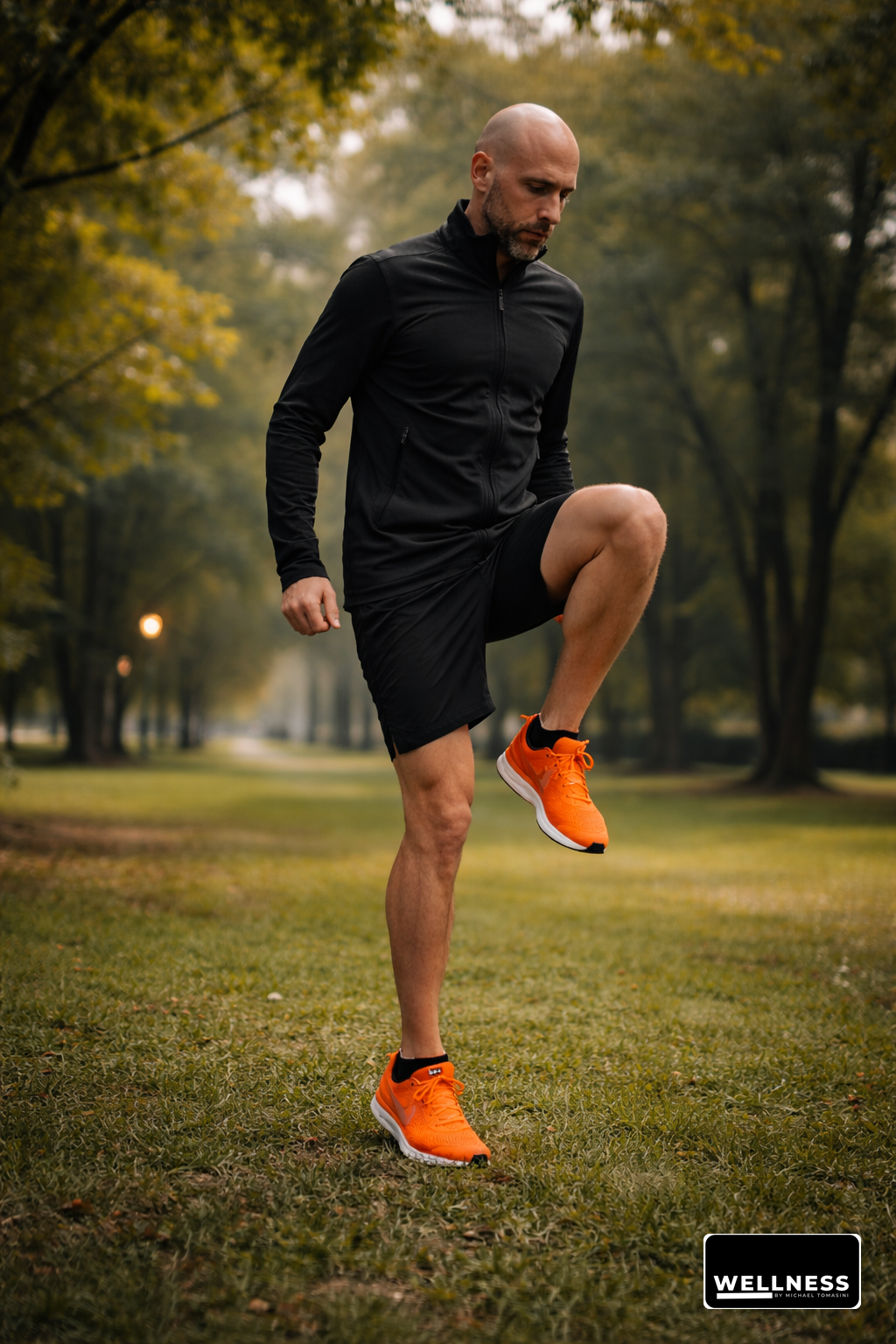
- high knees (2 × 15–20 m)
- butt kicks (2 × 15–20 m)
- fast-feet / quick steps (2 × 10–15 seconds)
- strides (2 × 15–20 seconds at “smooth fast,” not sprint)
This is the software update. You’re rehearsing rhythm and posture before you ask for speed.
Runner’s World’s “do drills 5–10 minutes after a warm-up jog and before speedwork” guidance fits well here.
3) Two minutes: the cadence nudge (only if you need it)
Cadence is a tool, not a religion.
If you tend to overstride or your knees feel beat up, try this cue for 30–60 seconds:
- shorter steps, quicker rhythm
- think: “feet under hips”
Research shows that subtle increases in step rate can reduce loading at the hip and knee joints. The practical takeaway is not “run at 180.” It’s: a small cadence bump can pull your foot strike closer under you and reduce braking.
4) Two minutes: micro-plyometrics (1–2× per week)
Optional—but powerful when dosed like espresso, not a bucket.
Pick one:
- pogos (two-leg ankle hops): 2 × 15–20 seconds
- single-leg pogos: 2 × 10–15 seconds per side (only if the two-leg version feels easy)
- low line hops: 2 × 10–15 (quiet landings)
Why so small? Because plyometrics are high-tissue stress: calves, Achilles, feet. Done right, they can support running economy; done recklessly, they can hijack your week.
The evidence is supportive but nuanced: strength training methods—including plyometrics—may improve running economy, and combining approaches can be especially effective. In middle-aged recreational runners, plyometrics or resistance training can improve economy without necessarily improving 5K time—translation: the body may become more efficient even if the stopwatch doesn’t immediately explode with confetti.
The rules that make this work (without breaking you)
This is the part most articles skip because it’s not glamorous.
The “quiet feet” rule
If landings get loud, stiff, or sloppy: stop. Quality over volume.
The “never after destruction” rule
Don’t do plyos after:
- long runs
- hard intervals
- a week where your calves already feel like piano wires
The “minimum effective dose” rule
The goal is not to win plyometrics.
The goal is to make running feel smoother.
What changes should you expect?
Realistic wins over 4–8 weeks:
- easier rhythm at easy pace
- better posture late in runs
- less “braking” feeling on contact
- more pop on strides and hills
What not to promise:
- guaranteed injury prevention
- instant PRs
- perfect form
The honest headline is: improved efficiency can set the stage for faster running, but it’s one piece of the performance puzzle.
The Economy Scorecard (the measurable version)
If you want to make this measurable without turning your life into a spreadsheet cult:
Once per week, repeat an Economy Check:
- 20 minutes easy on a similar route
- record: pace, average HR, and perceived effort (1–10)
- write one sentence: “How did my form feel at minute 15?”
You’re looking for trend lines:
- same pace, slightly lower HR
- same HR, slightly faster pace
- same everything, lower effort and smoother form
That’s the win.
Tools (gear-neutral, integration-ready)
This routine doesn’t require gadgets. But it’s friendly to them—meaning it’s easy to integrate without turning into a shopping list.
Optional tools that make it smoother:
- a simple timer
- a mini band
- a metronome app (or any beat source)
- water (and yes, hotel coffee still counts as a life form)
- shoes that fit well and don’t fight your foot
No brand is required for results. This is intentionally clean and modular.
The mindset shift that makes this stick
Most runners try to earn speed by suffering.
This is different: you build speed capacity by moving better.
Ten minutes isn’t a big ask. But it’s a powerful one—because it’s consistent, repeatable, and it travels.
Running faster is fun. Running smoother is sustainable.
And sustainability is what makes race-day performance possible in the first place.
Travel steals mechanics before it steals fitness.
So I train mechanics—briefly, consistently, and without drama.
Sources (for citation-safe claims)
- Runner’s World: “How to Run Faster: Form Tips & Drills” (Nov 20, 2025).
- Runner’s World: “Plyometrics Unlock Power in Your Running…” (Feb 12, 2026).
- Llanos-Lagos et al., 2024 (Sports Medicine): strength training methods (including plyometrics) may improve running economy.
- Barrio et al., 2023 (Kinesiology): plyometric jump training effects on running economy; combined plyometrics + resistance may show larger effects.
- Eihara et al., 2024 (Eur J Sport Sci): plyometrics and resistance training improved running economy without necessarily changing 5K time in middle-aged recreational runners.
- Heiderscheit et al., 2011: increasing step rate can reduce hip and knee joint loading during running.
The next steps:
- a clean Economy Stack mini-card (save-to-phone format), and
- a LinkedIn post.
 English
  Deutsch
  Français
Leave a Reply